
Business
ASML’s raised forecast turns AI chip demand into a lithography capacity race
ASML’s raised 2026 guidance shows AI-chip demand moving upstream into lithography capacity commitments, with Intel as the named High-NA proof point and TSMC/Samsung still unallocated.

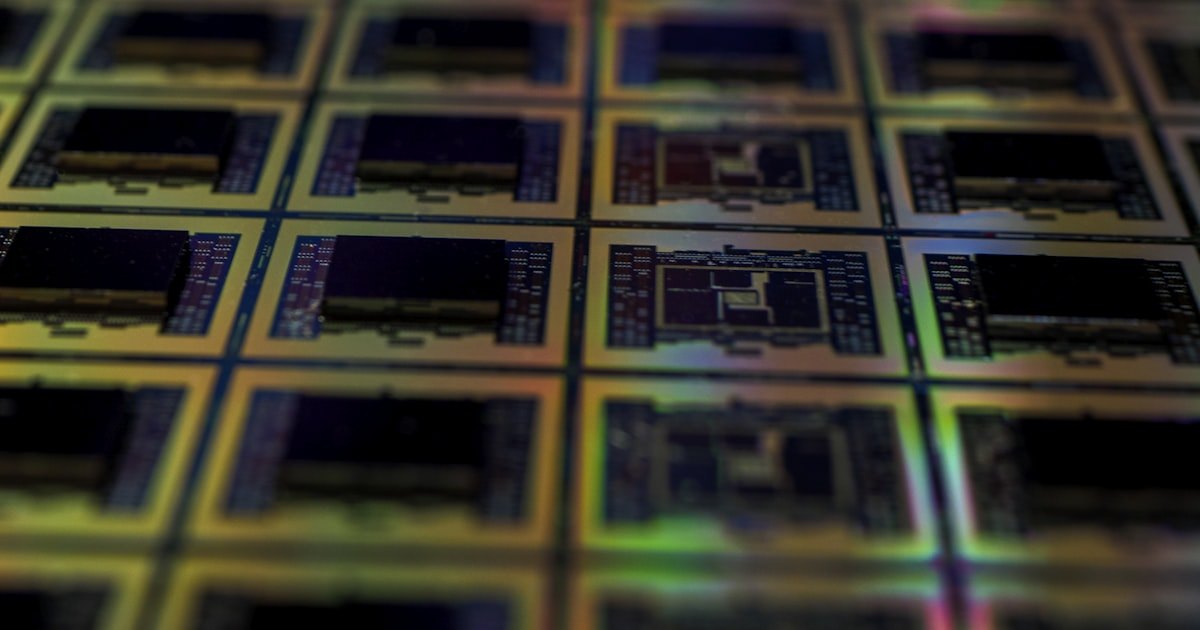
ASML lifted 2026 guidance after “extremely strong” first-half order intake, but the cleaner read for chip readers is capacity math: more low-NA EUV and DUV immersion output in 2027, a possible second step in 2028, and High-NA evidence that still points most clearly to Intel Foundry rather than every advanced foundry buyer.
ASML’s Wednesday results were not just a beat-and-raise quarter. They were a capacity signal from the company that still sits at the narrowest point of leading-edge chip manufacturing.
The Dutch lithography supplier reported second-quarter 2026 net sales of €9.326 billion, gross margin of 54.0% and net income of €2.918 billion. It also raised full-year 2026 guidance to €43 billion to €45 billion in net sales, with gross margin between 54% and 56%. For the third quarter, ASML guided to €11 billion to €12 billion in net sales and 55% to 57% gross margin.
The bigger line was buried in the CEO outlook: ASML said AI-related investments and demand for advanced logic and memory chips are pushing its customers to accelerate capacity expansion plans. CEO Christophe Fouquet said order intake was “extremely strong” in the first half and that ASML now plans to add 30% to its 2026 low-NA EUV capacity of about 65 systems for 2027. It is also investigating another 30% increase for 2028. For DUV immersion, ASML plans the same first step: add 30% to 2026 capacity of about 130 systems for 2027, with another 30% increase under investigation for 2028.
The arithmetic matters. A 30% lift on 65 low-NA EUV systems is roughly 19.5 additional systems, taking the 2027 capacity base to about 84.5 systems. A 30% lift on 130 DUV immersion systems is 39 additional systems, taking 2027 capacity to about 169 systems. If ASML later adds another 30% on the 2026 baseline, the two-year capacity ceiling would be about 104 low-NA EUV systems and 208 DUV immersion systems; if compounded on the 2027 base, it would be about 110 and 220, respectively. ASML’s wording does not specify which denominator it would use for 2028, so the safer copy is “another 30% under investigation,” not a precise 2028 unit forecast.
That is the orders-to-capacity story: customer commitments are now strong enough for ASML to publicly expand its own production envelope, but not specific enough to allocate those future tools by buyer.
On named foundry buyers, the cleanest primary evidence in ASML’s package is Intel Foundry. ASML’s investor presentation says High-NA EUV reached a new readiness milestone with a “first high-volume Logic product” and quotes Naga Chandrasekaran, executive vice president and general manager of Intel Foundry, saying Intel qualified the High-NA EUV process option on select Intel 18A product layers. That supports saying Intel is the named High-NA proof point in this ASML package.
For TSMC and Samsung Foundry, the story should be more cautious. They are the obvious leading-edge foundry comparables readers will ask about, and their advanced-node capacity plans are central to the market read. But ASML’s Q2 materials reviewed here do not name either company as a buyer tied to the new 2027 low-NA EUV or DUV immersion capacity additions, nor do they allocate the “extremely strong” first-half order intake by customer. Unless we get direct confirmation from ASML, TSMC, Samsung or a transcript answer, we should treat those buyers as response gaps rather than as confirmed order holders in this specific forecast.
The same caution applies to High-NA timing. ASML can point to Intel 18A qualification language, but High-NA is not the bulk capacity lever in the guidance paragraph. The explicit capacity expansion is for low-NA EUV and DUV immersion, the workhorse tools that determine how quickly foundries and memory makers can expand practical wafer output while High-NA moves from early manufacturing readiness into broader node planning.
One useful framing for readers: ASML’s 2026 raise says AI demand is no longer just showing up as accelerator revenue at Nvidia or hyperscaler capex. It is moving upstream into lithography commitments — the machines that make it possible for foundries and memory manufacturers to add the wafer starts behind advanced GPUs, custom AI chips, HBM-related memory flows and next-node logic.
But there is a trust line here. ASML’s statements are forward-looking, customer demand can be delayed or canceled, export controls can restrict shipments, and tool production depends on ASML’s own supply chain. The company itself flags risks around customer demand, order timing, cancellations, delays, push-outs, export controls and the ability to convert backlog and orders into sales. So the headline should not say “ASML confirms foundry capacity boom.” The defensible headline is narrower: ASML’s raised forecast shows orders are now strong enough for it to expand lithography capacity.
Sources
- ASML Q2 2026 financial results page
- ASML Q2 2026 press release PDF
- ASML Q2 2026 investor presentation PDF
Shadowfetch is a technology publication. Explore Shadowfetch Linux — our own Linux build — and the Shadowfetch apps on the App Store.
Sources
- ASML Q2 2026 financial results page
- ASML Q2 2026 press release PDF
- ASML Q2 2026 investor presentation PDF
The article says this was based on ASML’s Q2 2026 results page, press release and investor presentation.
Evidence types: official data, company press release, investor presentation, public statements
Links verified
See a problem in this story? Report an error · Corrections policy · Our methodology
The Daily Download
One morning email: the day’s biggest technology stories — AI, new devices, and the companies shaping them.
Related coverage
 Business
ASML’s Raised Forecast Says the AI Chip Boom Is Moving From Hype to Factory Orders
Farah Al-Jamil ·
 Business
AI Agents Are Starting to Break the Old SaaS Pricing Model
Farah Al-Jamil ·
 Business
Hormuz Shock Sends Oil Higher and Puts a Fresh Supply-Chain Risk on Every Earnings Call
Farah Al-Jamil ·