AGENT OASIS 3.0 · OPEN SOURCE FOR macOS

Agent Oasis

Private decision intelligence for the products you sell, the agents you run, and the money you spend — now with Hermes Fleet as a first-class module for a real agentic-operations install.

Version 3.0.1. Signed and notarized for Intel and Apple silicon. Free and open source, with no account, server or telemetry.

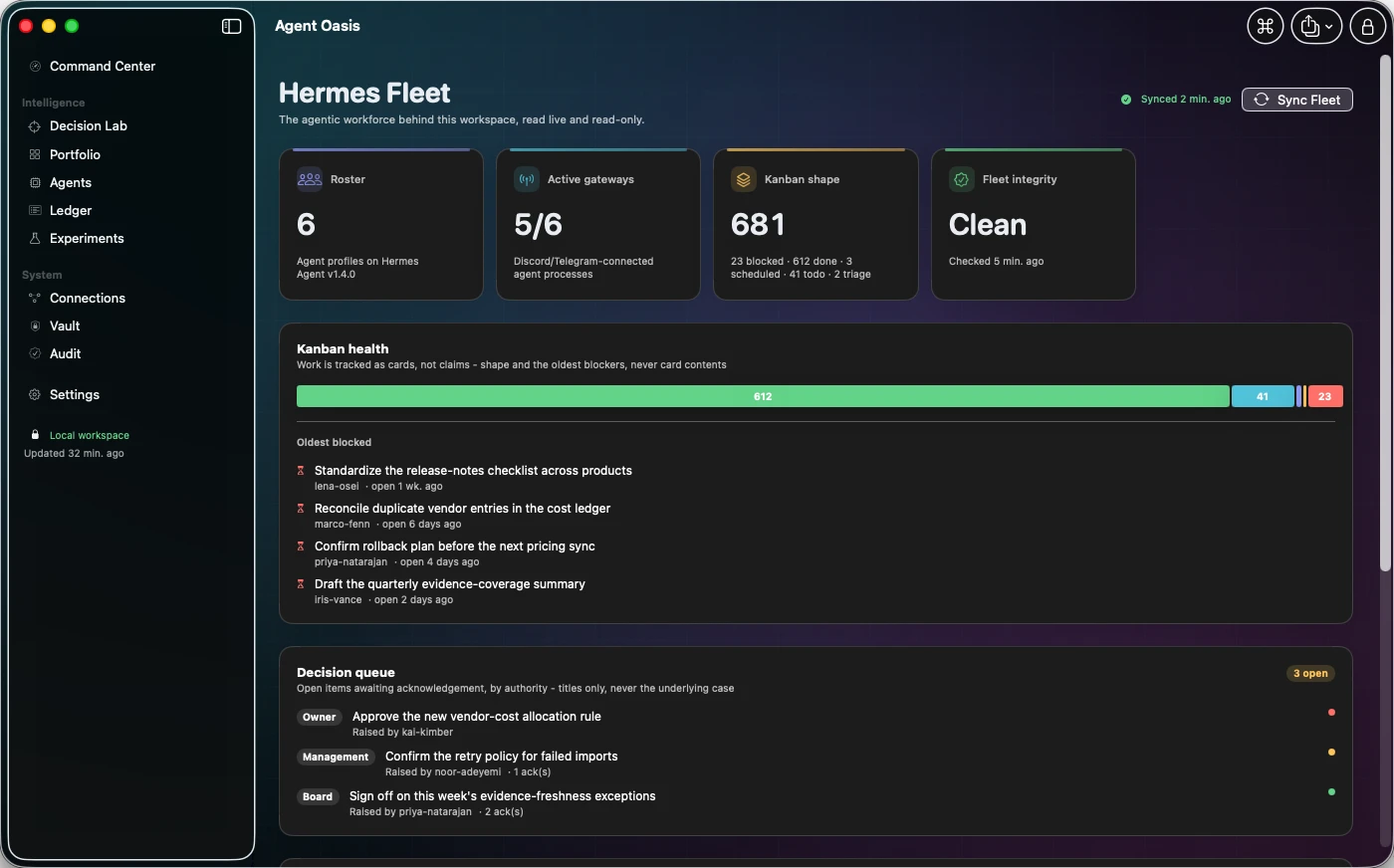
The Hermes Fleet dashboard in Agent Oasis, showing a roster of agents, a kanban health bar split by status, the open decision queue grouped by authority level, and per-agent session and token telemetry
Hermes Fleet. Kanban shape, the decision queue, and roster - read live, redacted by construction.

Hermes is the leader in agentic operations. Now it is a tab, not a button.

Earlier releases synced a Hermes install for a handful of aggregate token counts, tucked behind a button in the Agents tab. 3.0 makes it a first-class module: live kanban shape and its oldest blockers, the open decision queue by authority level with an ack-deadline urgency indicator, roster, gateway process liveness, and structural fleet integrity — all read over one hardened SSH round trip per sync.

Kanban card bodies and decision context, recommendation, and options text — which on a real install carry internal strategic content — are never decoded into the app. The Swift models simply have no property to hold that data, so the decoder drops it before a value exists. Two tests re-encode a parsed model built from a real sensitive-looking payload and assert the sensitive text is verifiably absent, not just that a differently-named field is missing.

This is not Shadowfetch-specific. Any Hermes install works, provided its host answers to ssh <host> and its profile, tools, and state directories match Settings — every path is validated against the same injection-resistant charset already used for the hostname. Read the full contract:docs/HERMES-FLEET.md.

Why it exists

If you run AI agents, someone will eventually ask what they are worth. The honest answer usually contains a few real invoices and several educated guesses — an estimated hourly rate, an estimate of the hours saved, an estimate of the revenue influenced. Most tools add those together and print a single confident figure.

That figure inherits the weakness of its worst input while looking as precise as its best one. Agent Oasis refuses to produce it.

Cash and estimates never merge

Most tools that price AI work add three guesses to one invoice and print an ROI. Agent Oasis computes them separately and never sums them. Money that moved is one number; capacity you modelled is another. They sit side by side, labelled, and the app will not blend them for you.

Confidence measures evidence, not activity

An agent whose value inputs were all typed by hand scores zero confidence, no matter how many tasks it completed today. Being busy is not being measured. Staleness can lower the score; nothing can inflate it.

Experiments refuse to guess

Record a confounder on an experiment and the app will not report a lift. A number a reader cannot separate from seasonality is worse than no number, because it gets repeated without the caveat that was the whole finding.

Nothing is invented

A new workspace is empty. There is no sample data in the shipped app at all - the generator lives in the test target, so the binary cannot fabricate a record even by accident, and a test fails if that ever changes. Hermes Fleet holds itself to the same rule: there is no fleet-wide “duty success rate” anywhere on a real Hermes install, so the app does not report one.

What is in it

Command Center
Honest cash, modelled value, coverage, trends, and an actionable Attention Inbox.
Hermes Fleet
Live kanban shape and its oldest blockers, the open decision queue by authority, roster, and gateway liveness for a real Hermes install.
Decision Lab
Evidence-ranked portfolio postures, Agent Frontier, Scenario Studio, checkpoints, and executive briefs.
Portfolio
App Store Connect records, imported Sales and Trends figures, per-app history.
Agents
Cost, supervision, capacity, revenue influence and ROI - split by provenance.
Ledger
Cash and modelled value as separate entry types, each with its own confidence.
Experiments
Baselines, observation windows and confounders that block false attribution.
Vault
Encrypted secrets and a credential inventory that reads metadata only, never contents.
Audit
A hash-chained trail - editing or removing an entry is detectable.
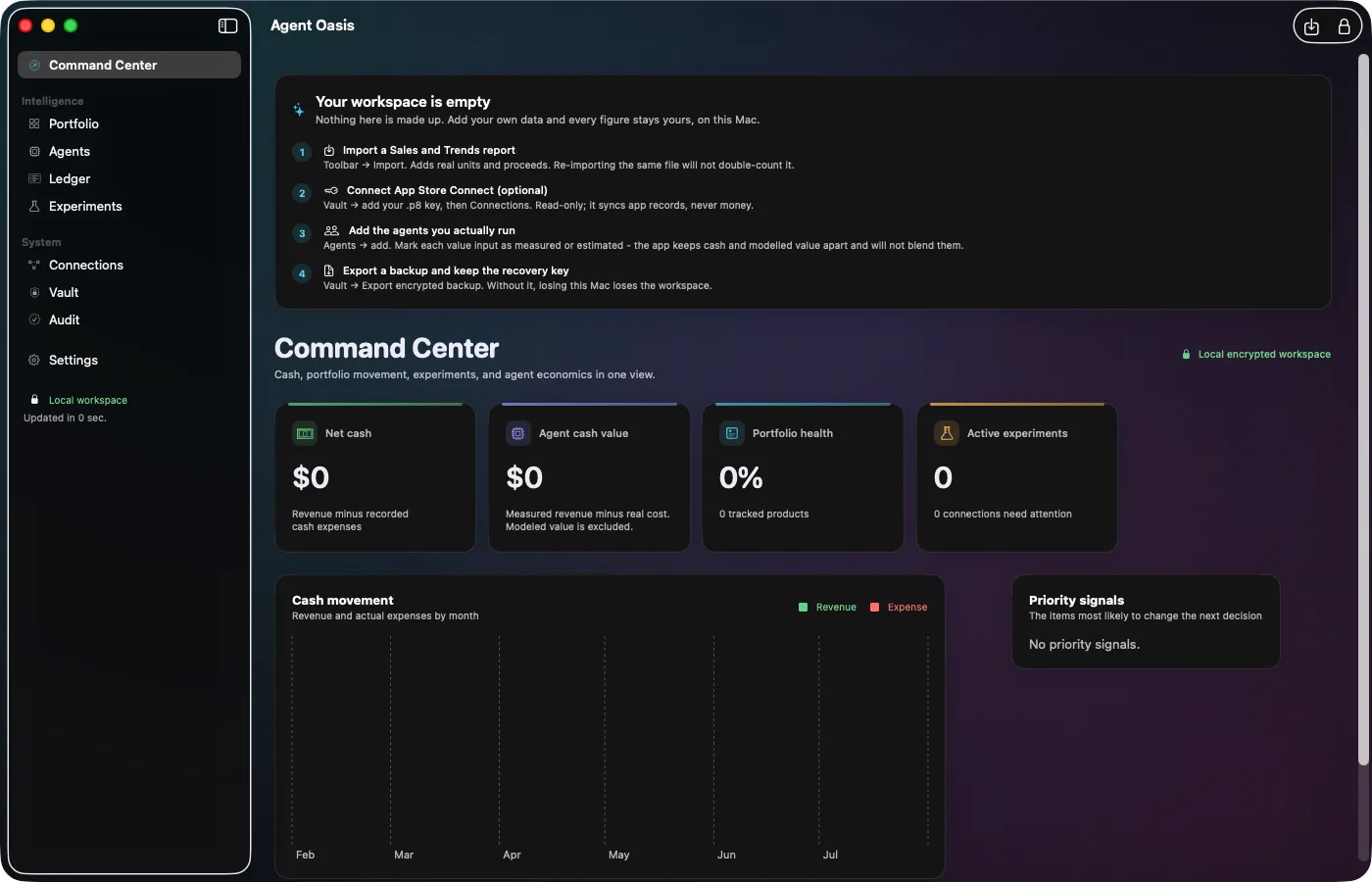
A new Agent Oasis workspace, empty, with every figure reading zero and a four step getting started panel
A new workspace is empty. Every headline reads zero because nothing has been measured yet, and the app says so rather than filling the screen with samples.

What to know before using it

This section exists because the product argues that unverifiable claims should be labelled. A page about it that hid its own gaps would be arguing against itself.

Source builds need their own signing identity

The workspace key is bound to owner presence, so Touch ID guards the key rather than just the window. The official download is signed and carries the entitlement required for macOS's data protection keychain. A locally built unsigned copy falls back to the older keychain rather than refusing to open your ledger - real protection either way, but not the strongest one.

It is version 3.0.1, written by one person

80 tests, zero warnings, and continuous integration that fails on any Swift warning or a debuggable release build. That is a floor, not a guarantee. Export an encrypted backup and keep the recovery key before you rely on it for anything that matters.

Hermes Fleet expects a particular layout by default

The Hermes Fleet panel reads profiles, tools, and state over SSH from configurable paths. If your install is organised differently it will find nothing for that section - and it says exactly which directory it searched, rather than showing an empty panel with no explanation.

What leaves your machine

Two hosts appear anywhere in the source, and both are opt-in. There is no analytics, no telemetry, no crash reporting and no update check. You do not have to take that on trust — the repository is public, and one command checks it:

grep -rhoE "https?://[a-zA-Z0-9.-]+" AgentOasis | sort -u
  • api.appstoreconnect.apple.com — only if you add your own App Store Connect key. Read-only.
  • Your own SSH host — only if you configure Hermes Fleet. Every remote command is a read: cat, list, stats, --version, or systemctl list-units. Nothing on the remote host is started, stopped, written, or deleted.

The workspace is encrypted with AES-256-GCM before it is written to disk, at file mode 600, with the key held in your Mac's Keychain. An exported CSV is deliberately plaintext; encrypted backups need the recovery key you stored separately.

Install Agent Oasis

Download the signed universal DMG, open it, and drag Agent Oasis into Applications. It requires macOS 14 or later and runs on Intel and Apple silicon. No Xcode, Terminal, account, or API key is required.

Signed one-click download

The universal DMG is signed with a Developer ID certificate, notarized by Apple and accepted by Gatekeeper. SHA-256:

d3ef31e8bb98d15afe168cd95d0a17ef8cfced59cd05f392852160ef447cfec7
Developer option: build from source
brew install xcodegen
git clone https://github.com/ShadowfetchAI/agent-oasis.git
cd agent-oasis && xcodegen generate
open AgentOasis.xcodeproj

Press ⌘R. No account, no API key and no Apple team ID required to run it.